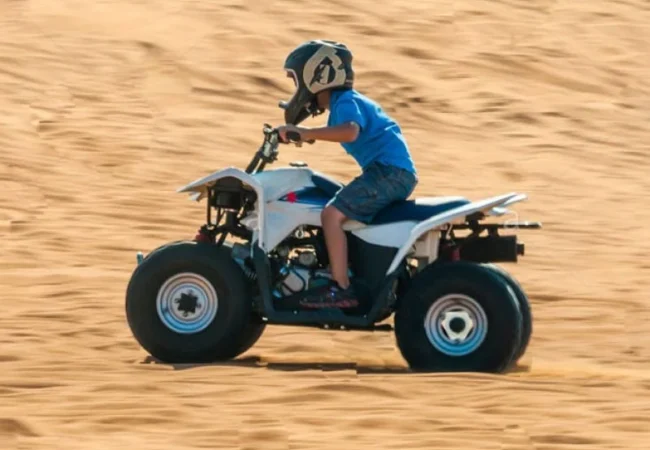
 AED 150
Yamaha 90cc
- Ages 9-12
- Track
- Supervised
Good habits start on this machine — even on the short supervised loop, a staff member keeps an eye on grip and posture just like the lead guide does out on the main route.
Book this ATV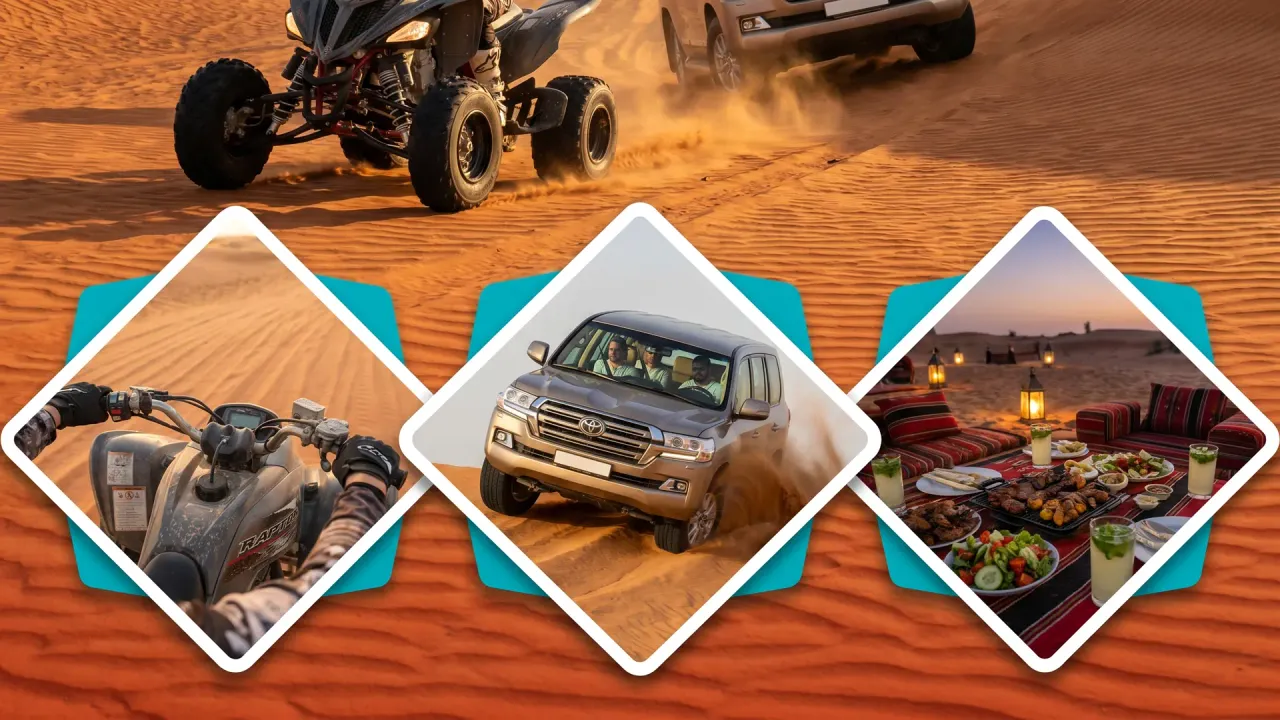
A guide clocks how you're handling the throttle and your stance during the warm-up, then spends the rest of the session correcting it as the terrain gets harder. You get a Yamaha to yourself and real coaching on how to ride it well, whether that's the supervised children's 90cc or the Raptor 700cc at the top of the range.
Every session at Al Lahbab starts about 45 minutes past Downtown, and the whole idea is one Yamaha to yourself with a guide watching your hand on the throttle from lap one, not a rental handed over and left alone. Which machine you're on is what sets the price: AED 200 starts an adult on the 220cc, AED 250 covers the 400cc — the one most people end up riding — and AED 795 for the Raptor 700cc stays off-limits until a guide has personally checked how you ride. Riders aged nine to twelve get their own coached 90cc lane for AED 150.
Ask what to book first and the answer is nearly always the same: evening dune bashing paired with your own ATV run and a Bedouin BBQ dinner at camp, AED 375 total, the single most-booked combination this site sells. Secure online advance payment confirms your booking — the team answers WhatsApp questions any hour, any day.
Pricing runs per rider, because a Yamaha normally carries exactly one person — the lone exception is the 400cc double, which seats two riders under a single fee. Which machine you actually get is decided at the warm-up rather than ticked off a menu in advance, so no payment gets taken until your route, your timing and your pickup are all settled.
| Machine | Suits | From |
|---|---|---|
| Yamaha 90cc | Children 9 to 12 on the supervised track, guardian close by, corrected as they go. | AED 150 |
| Yamaha 220cc | Riders who have never rolled a throttle before. Light and forgiving while the basics click. | AED 200 |
| Yamaha 400cc | Where most of the coaching happens. Solid enough to reward good habits without punishing early mistakes. | AED 250 |
| Yamaha 400cc double | Two riders sharing one machine and one fee, technique split between them. | AED 350 |
| Yamaha 400cc turbo | Same frame, sharper throttle response. Booked by riders refining technique on a repeat visit. | AED 350 |
| Yamaha Grizzly 450cc | Heavier and more planted. The pick once your body position over rough ground is already solid. | AED 450 |
| Sports quad 625cc | Rewards a rider who is already standing and shifting weight correctly. Unforgiving otherwise. | AED 700 |
| Yamaha Raptor 700cc | Fastest on the fleet, and the most technique-demanding. Released only after a guide checks your control. | AED 795 |
Since coaching is baked into every session, which exact machine you pick matters less than most first-timers assume walking in. Choose whichever one feels comfortable, and the guide shapes both the route and the corrections around it.
AED 150Good habits start on this machine — even on the short supervised loop, a staff member keeps an eye on grip and posture just like the lead guide does out on the main route.
Book this ATV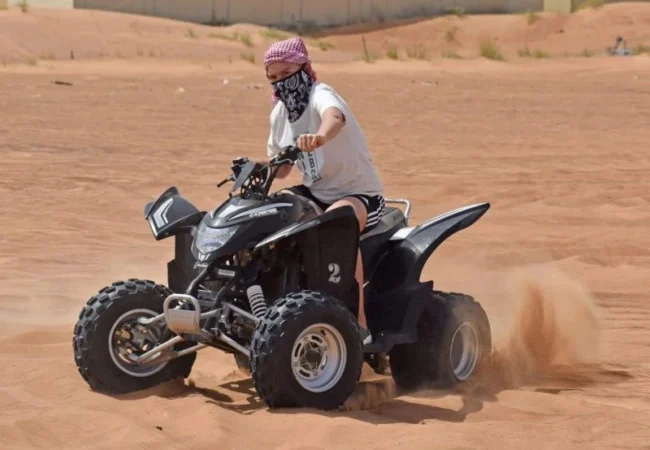 AED 200
This is where most beginners build throttle control from zero. It's forgiving enough that an early slip-up earns you a wobble rather than a spill.
Book this ATV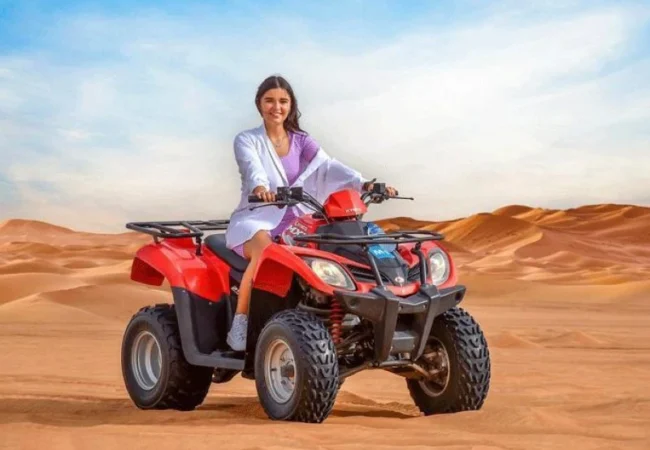 AED 250
The machine that carries most of this site's actual coaching — enough power to reveal a technique flaw without being harsh enough to punish you for it.
Book this ATV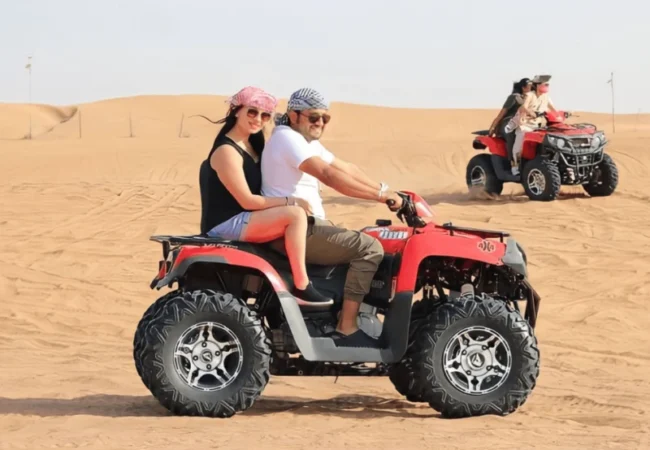 AED 350
Two riders share one machine, and the guide's corrections go to whichever one of you is holding the throttle at that moment.
Book this ATV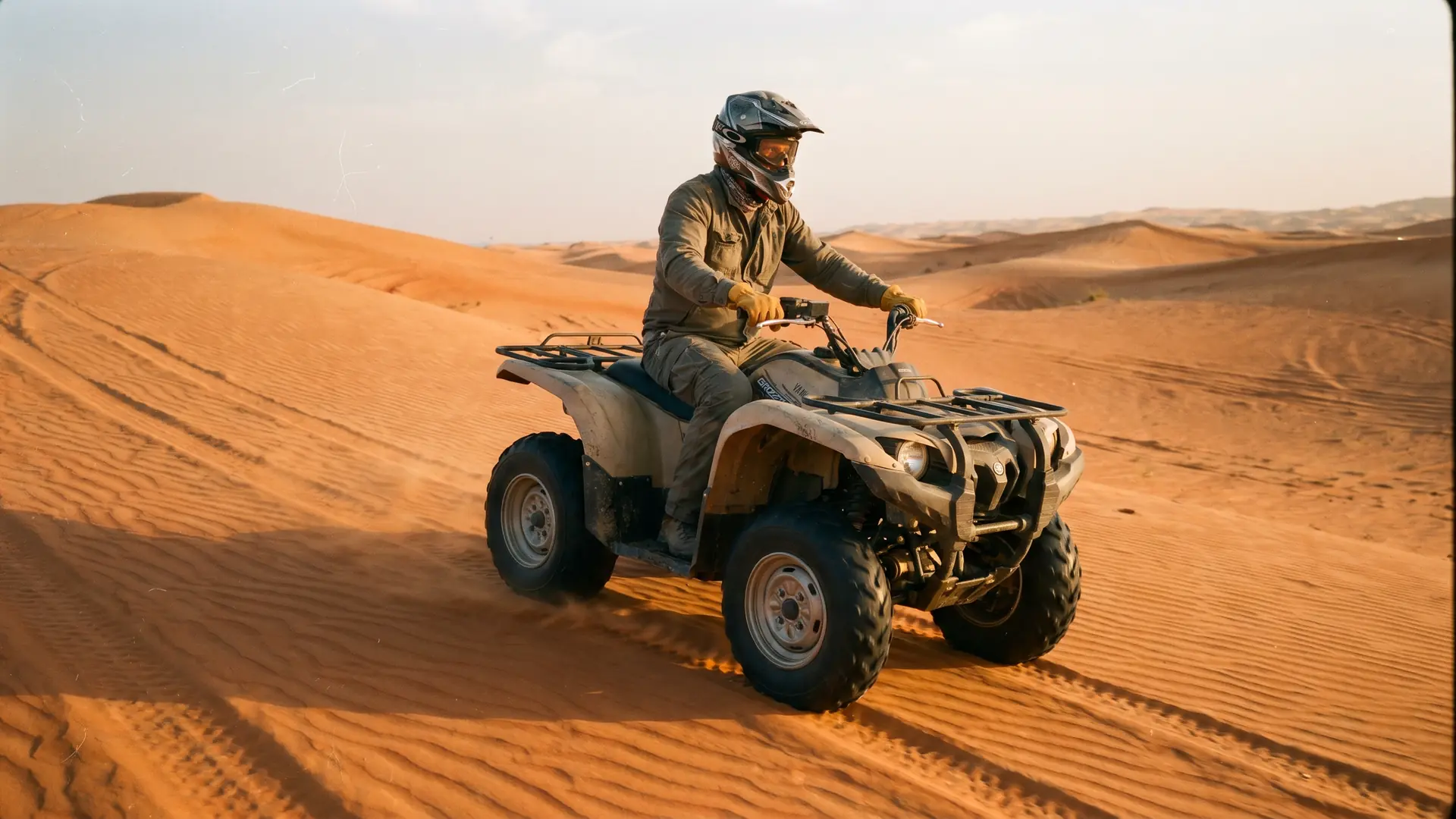 AED 350
It shares its frame with the standard 400cc but answers to your hand faster. Riders sharpening their technique on a second or third visit usually ask for this one.
Book this ATV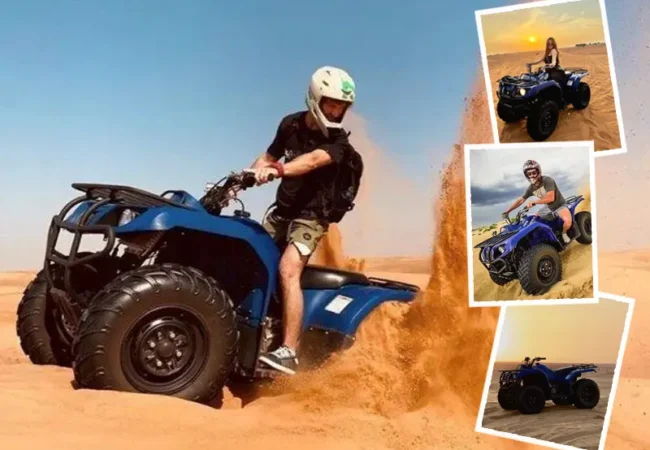 AED 450
Heavier and more planted over rough ground, forgiving toward a body position that's still a work in progress. Well suited to longer, tougher routes.
Book this ATV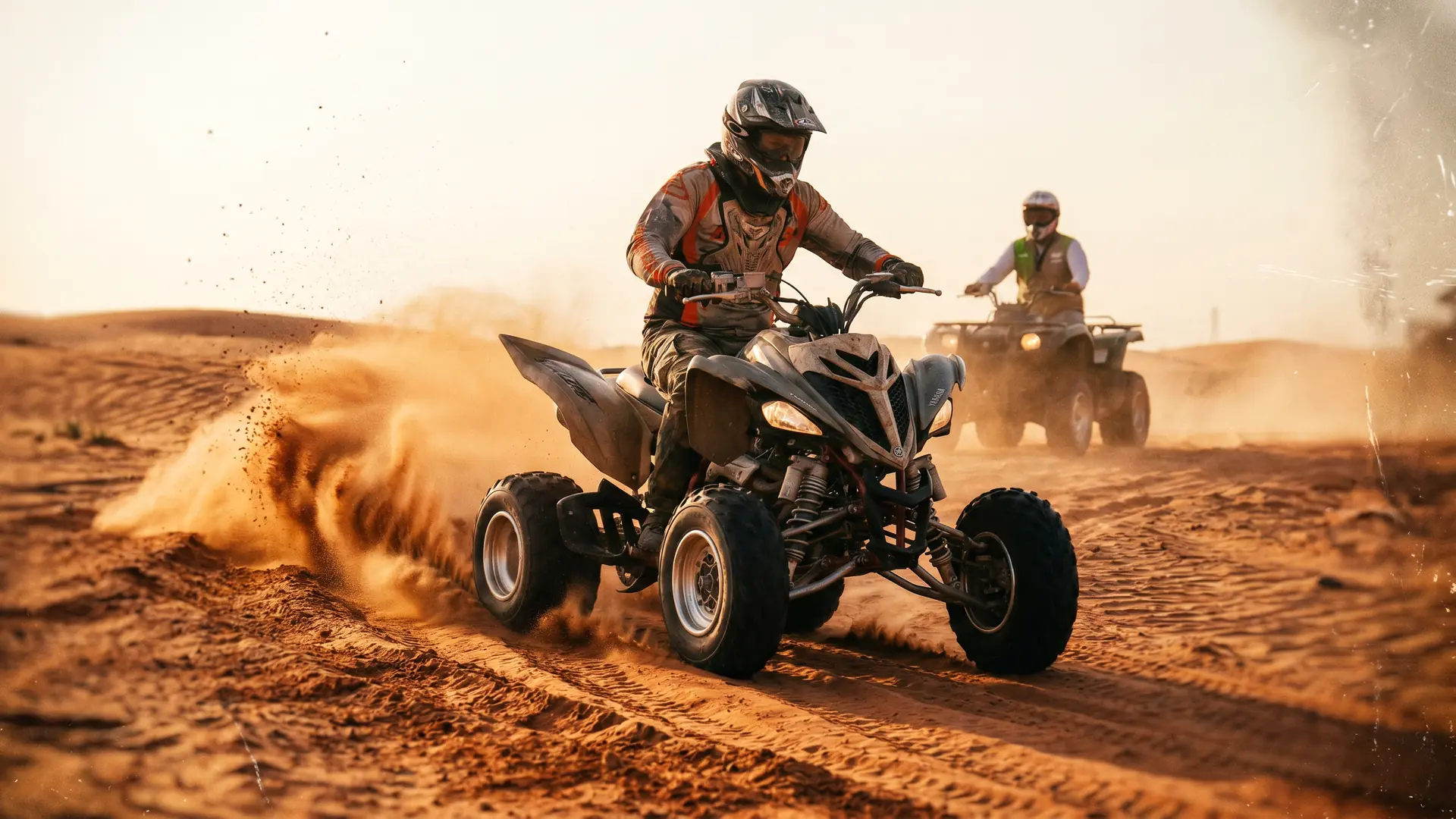 AED 700
It responds instantly to every shift in your weight, for better or worse. Riders who've already put in the technique work tend to request this one specifically.
Book this ATV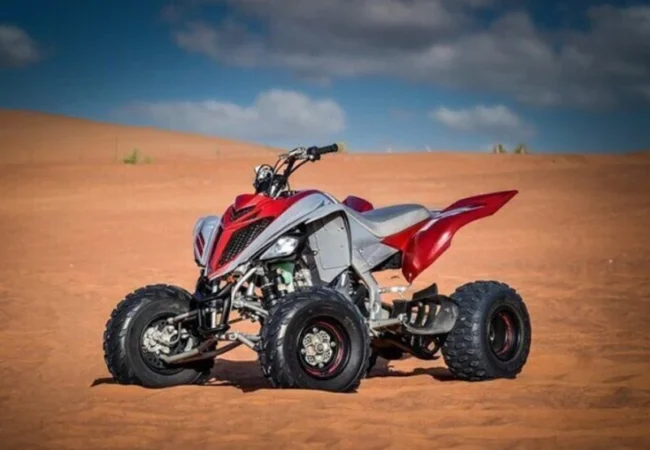 AED 795
This is the technique ceiling of the whole fleet. A guide will walk through your riding history before handing over the keys, because this machine won't cover for bad habits.
Book this ATVCoaching takes the same amount of time whether you book the standalone session or one of these. Since the drive out already costs forty-five minutes each way, most riders fold in the safari and dinner rather than turn around after one hour on the machine.
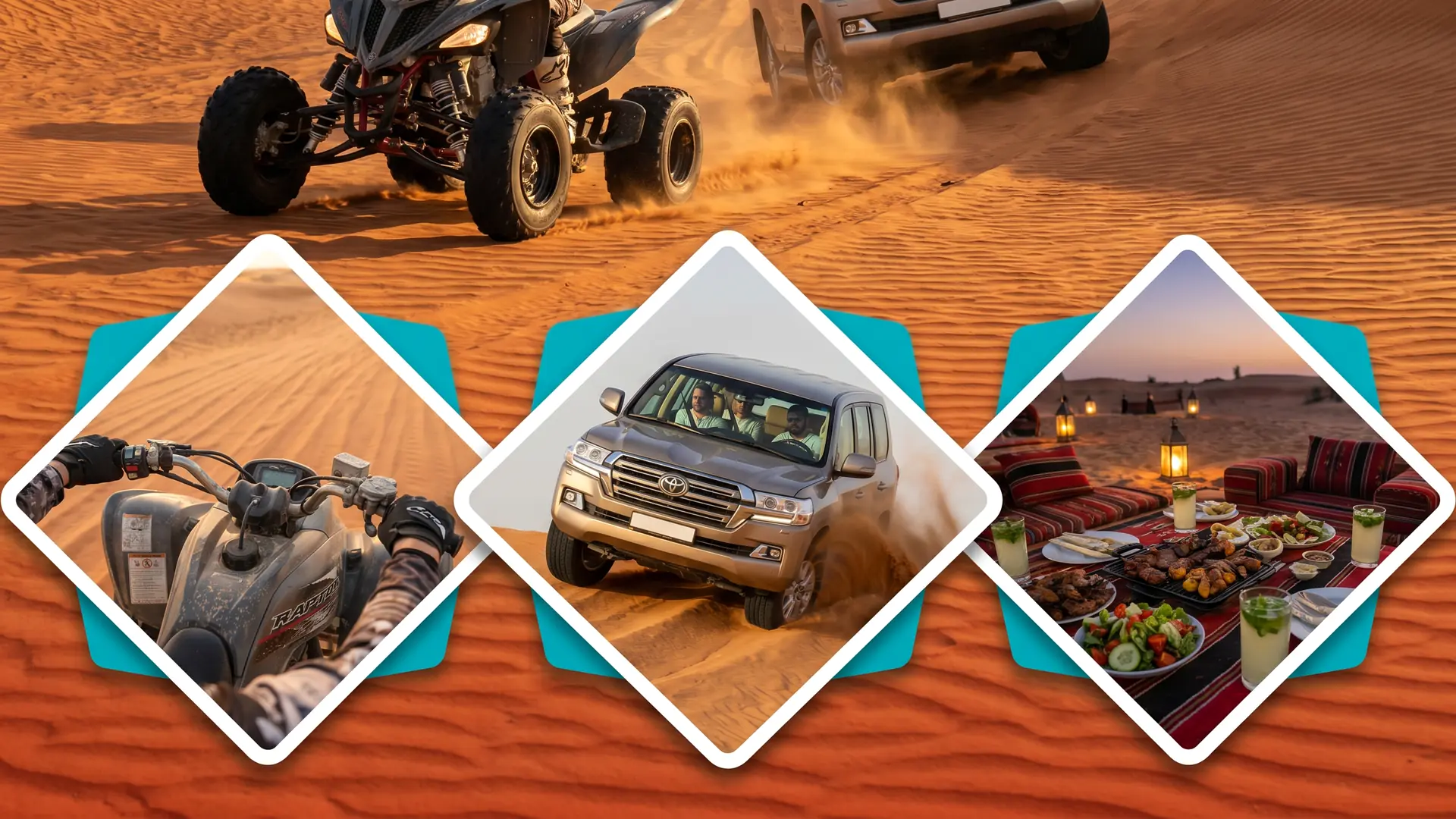 AED 375
The dune bashing happens in a Land Cruiser, your own coached ATV session comes next, and sunset over the ridges leads straight into the halal BBQ camp with sandboarding and a tanoura show by the fire. The busiest booking on the list.
Book this tour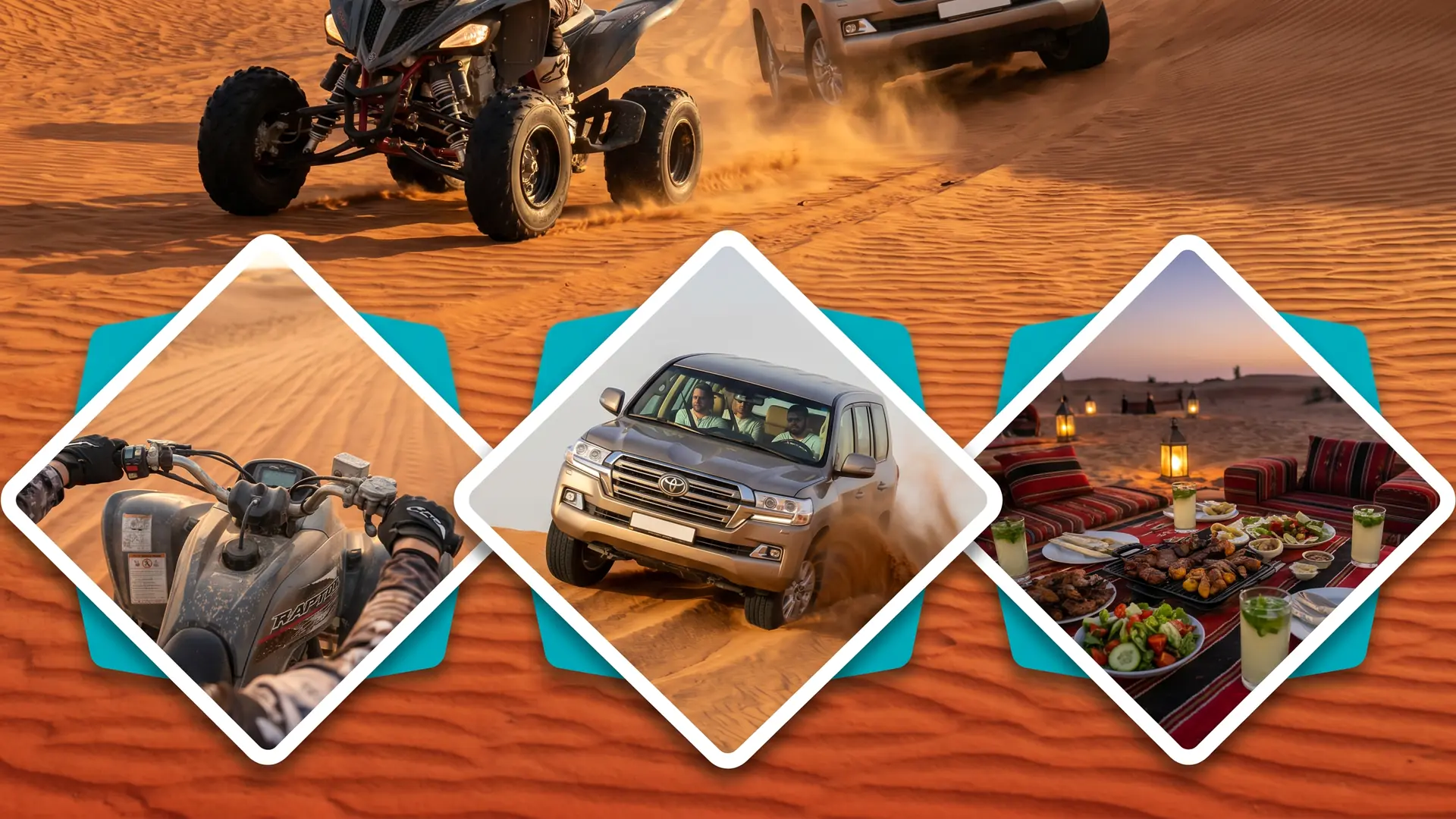 AED 290
Overnight cool leaves the sand firmer, which forgives a shaky throttle hand and makes this the easier slot for actually learning, and it wraps up early enough that the whole afternoon is still yours.
Book this tour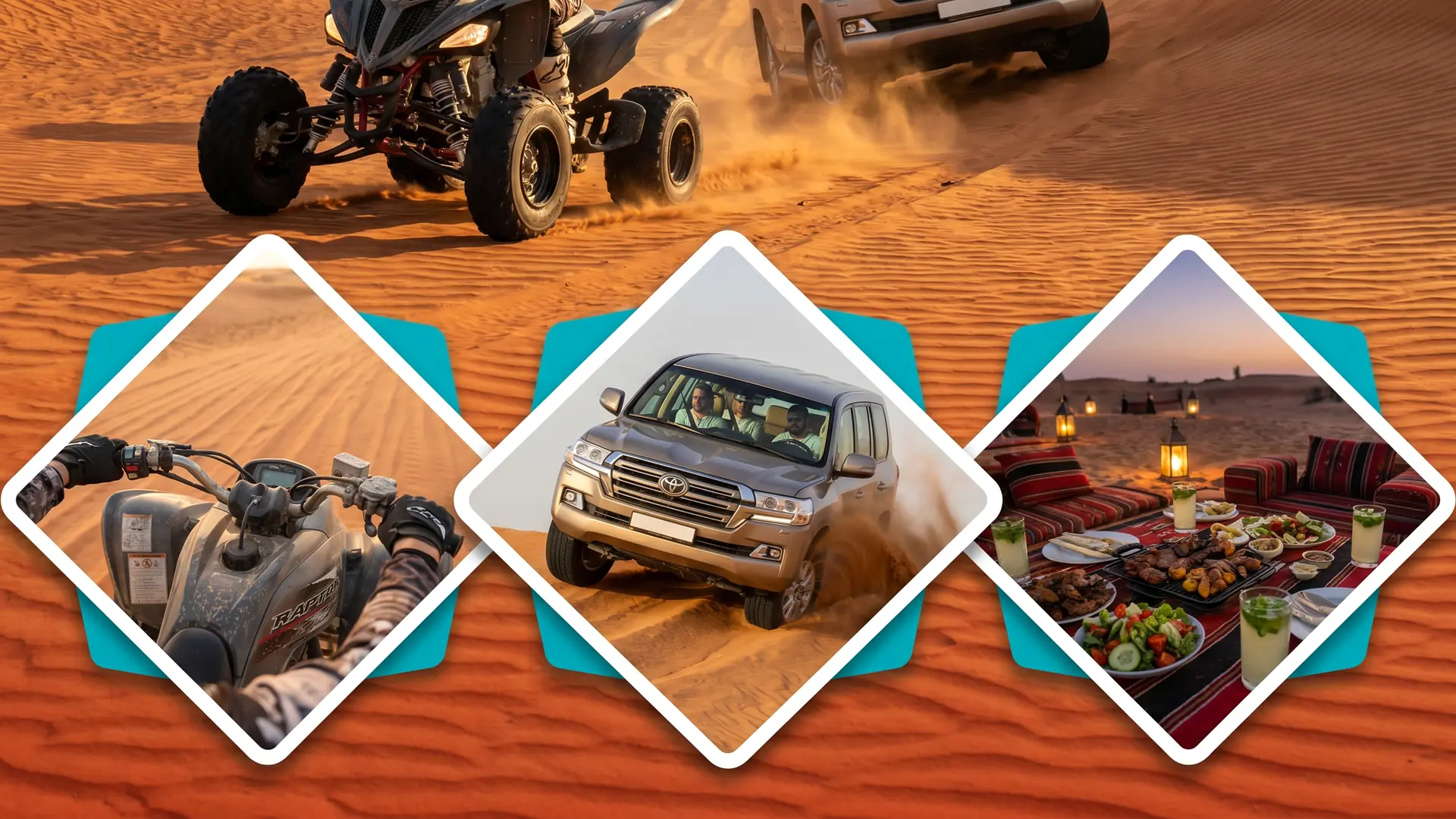 AED 700–1,300
Made for anyone who'd rather grip their own throttle than ride shotgun in someone else's 4x4. Skip the dune bashing, keep the coached ATV time plus dinner at camp — what you pay shifts with the machine you settle on.
Book this tour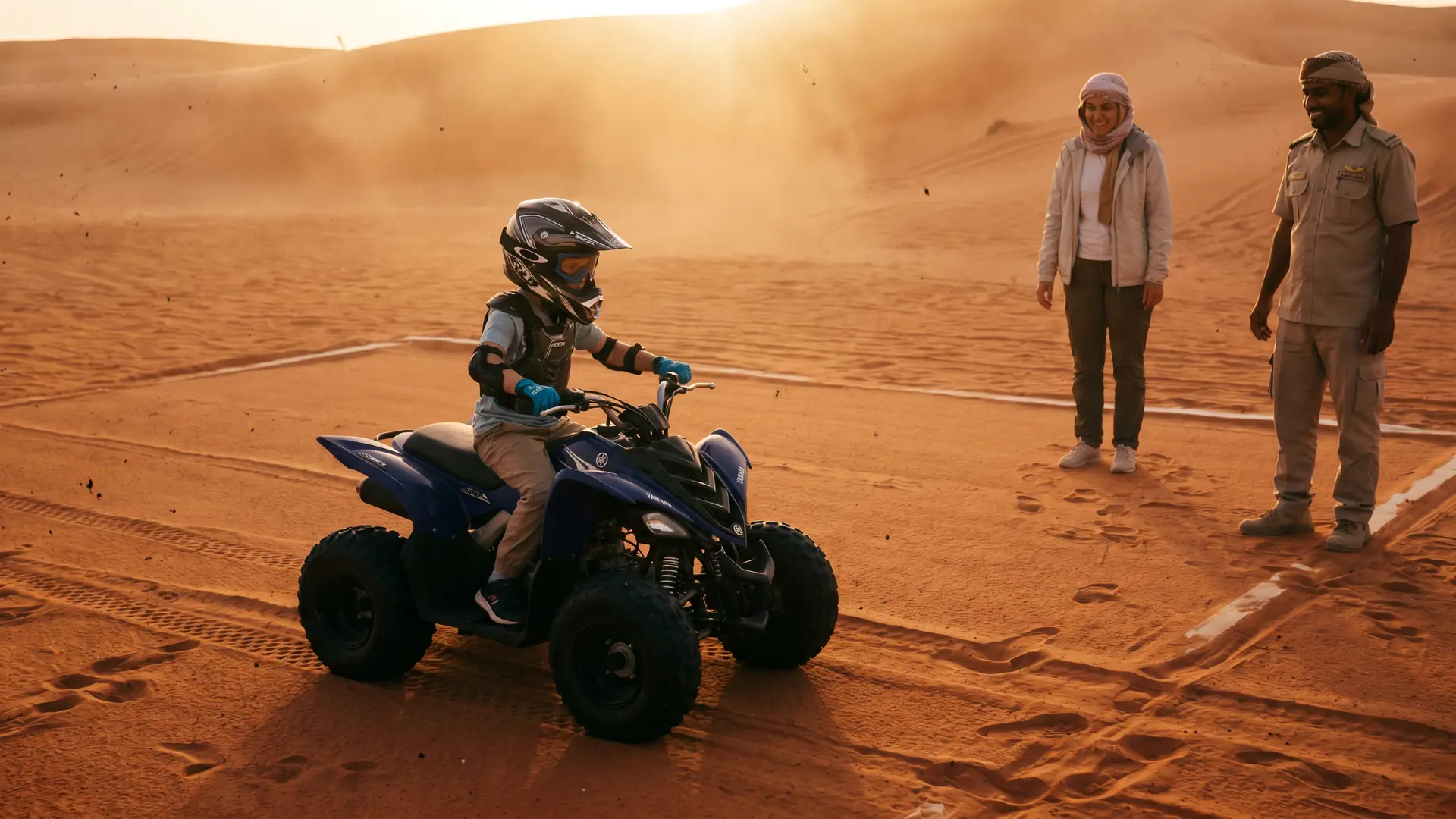 AED 150
The kids get the same corrections on the 90cc track while adults cover the full route in that identical window, based at the same site so nobody ends up idle waiting on the other group to finish.
Book a family tourA car license doesn't tell the guide anything useful — what they actually want to know is whether you've spent time on a motorbike, a jet ski, or anything else that's already taught your right hand what a throttle feels like.
Most people underestimate how much the drive itself shapes the booking.
A buggy asks less of your technique than an ATV does — a steering wheel and pedals feel closer to a car than a throttle in your palm does. Plenty of riders here book both machines back to back.
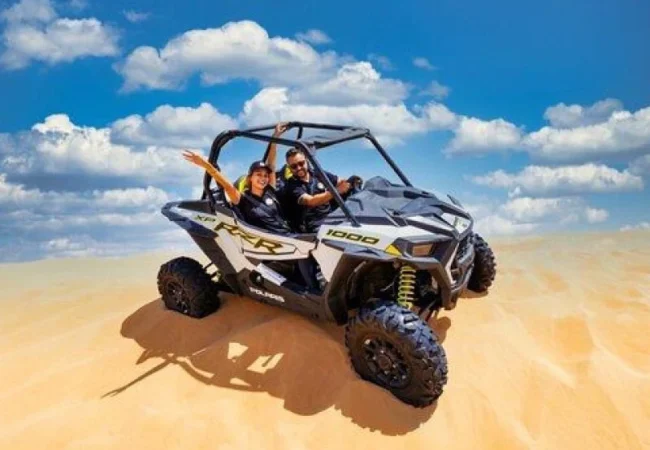
The entry buggy. Steady and readable enough that a misjudged line is easy to correct before it becomes a problem.
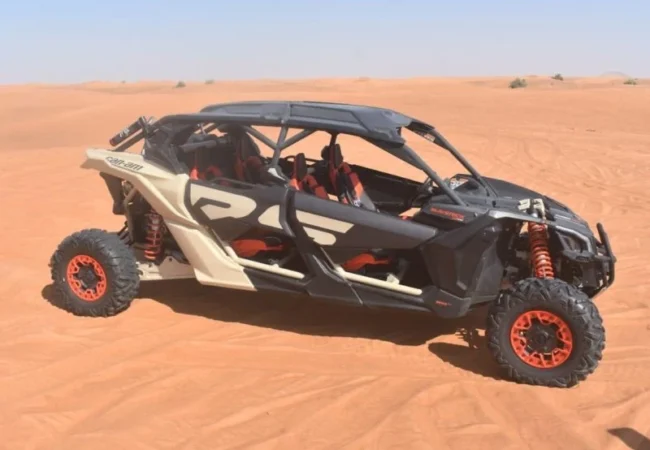
Wide-set and long through the suspension travel, with room enough to move the whole group in a single trip — one flat fee covers the buggy, never a per-seat charge.
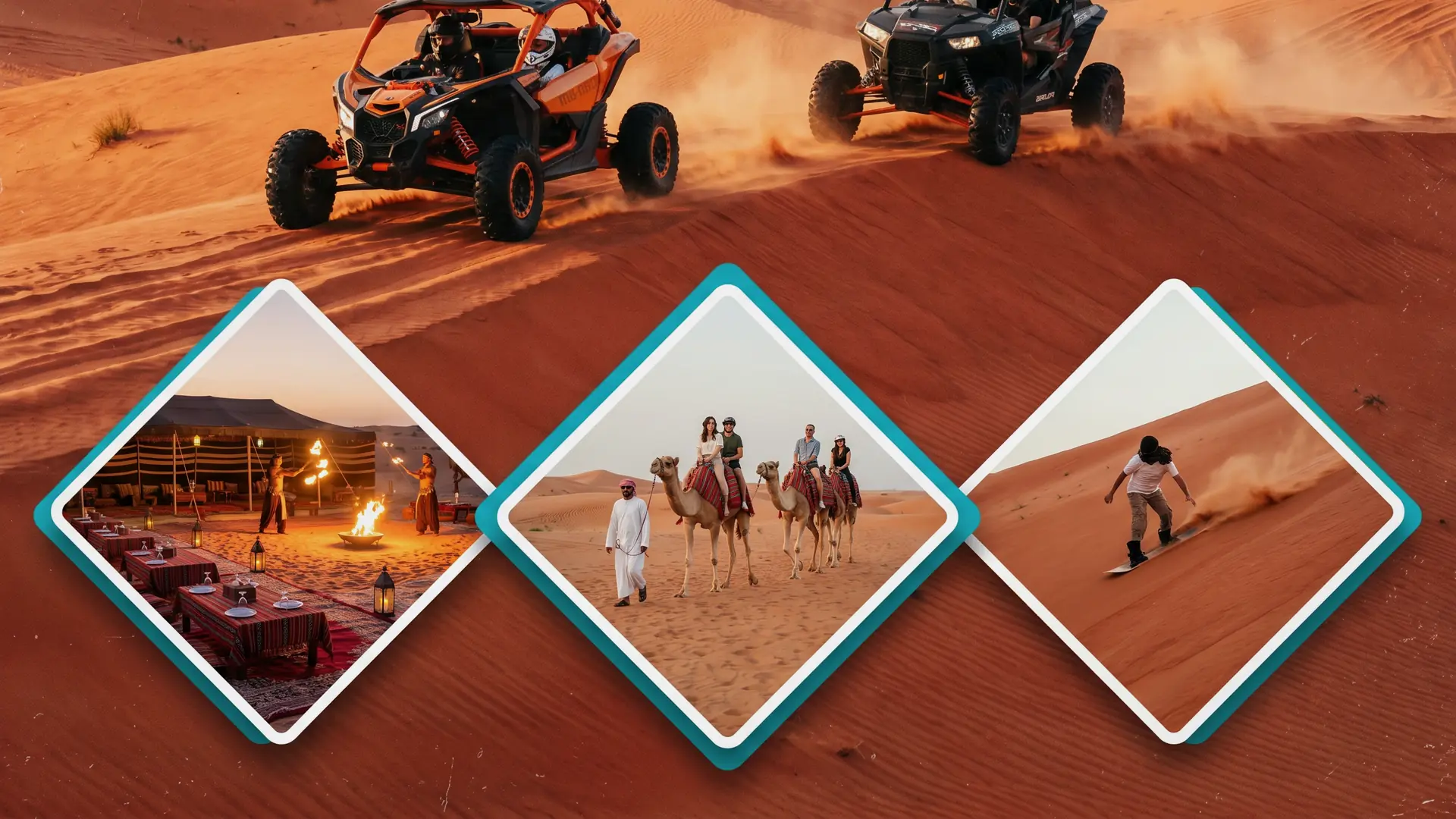
Spend the first half building ATV technique before your arms tire out, then switch into the buggy for the back half. Once machines are chosen, figure on somewhere between AED 290 at the low end and AED 1,100 once you upgrade both legs.
This is the one booking where questions come before a yes. An ATV's four wheels forgive a lot of sloppy technique in soft sand; a KTM forgives almost none of it, and nothing about the machine compensates for what your body isn't doing right.
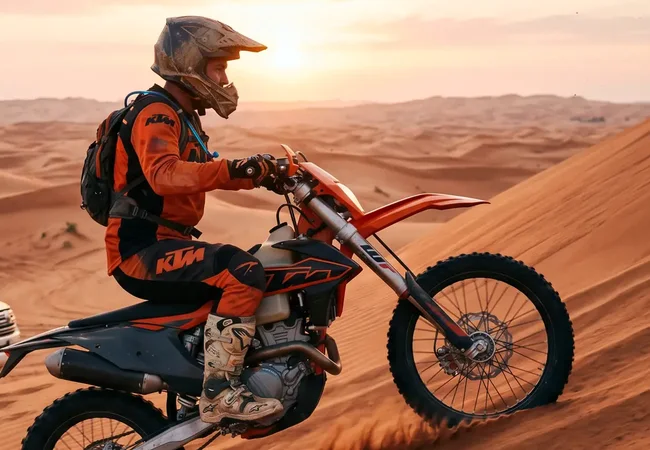
An hour on the KTM 450 runs AED 850; a second hour brings the total to AED 1,250. Turn up with genuine off-road hours behind you, because keenness by itself won't keep a dirt bike upright in loose sand.
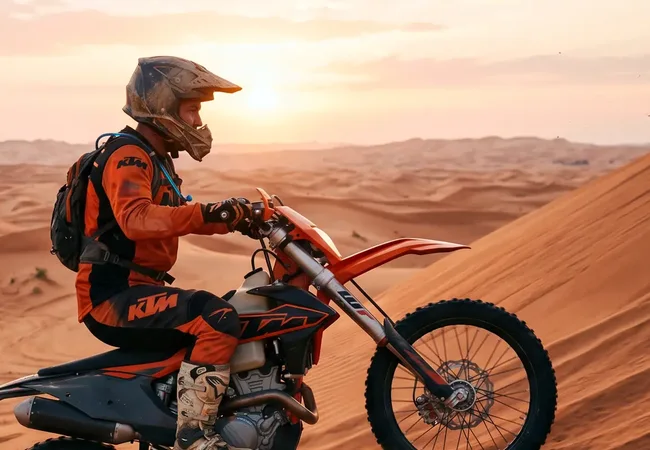
Reserved for the advanced route, handed over only once a guide has watched your technique hold up under pressure. Pricing follows that check rather than a fixed rate.
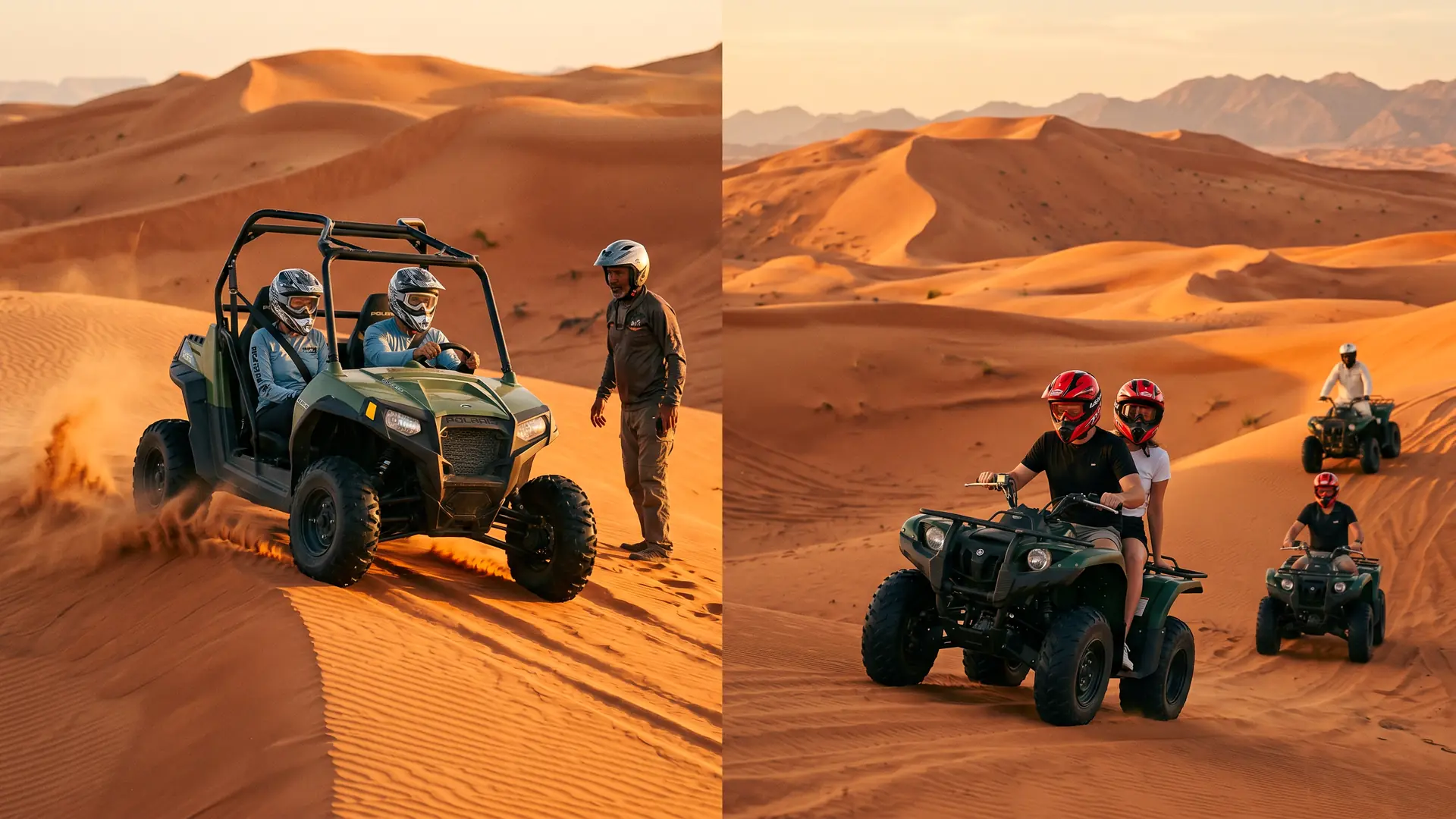
Failed the KTM check? The Raptor 700cc still gets you close to that rush, minus the two-wheel technique demands, plus the stability of four wheels under you.
From AED 225, a professional driver handles a Land Cruiser safari for you — no throttle hand to train, no body position to correct, just the dune bashing done on your behalf.
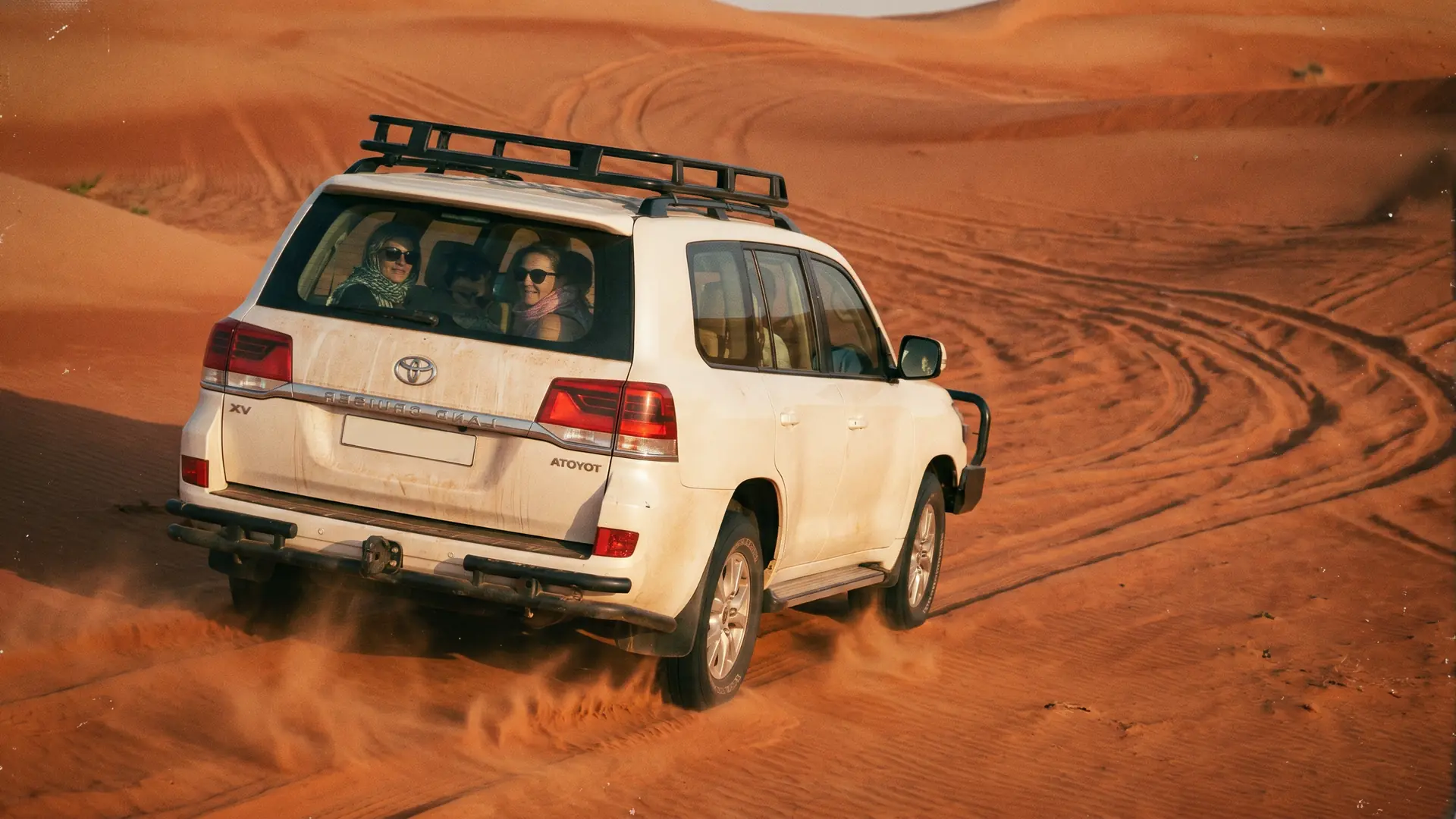
Wheels roll before the heat builds, while the sand still carries its night-time chill, putting you back in the city well before lunch.
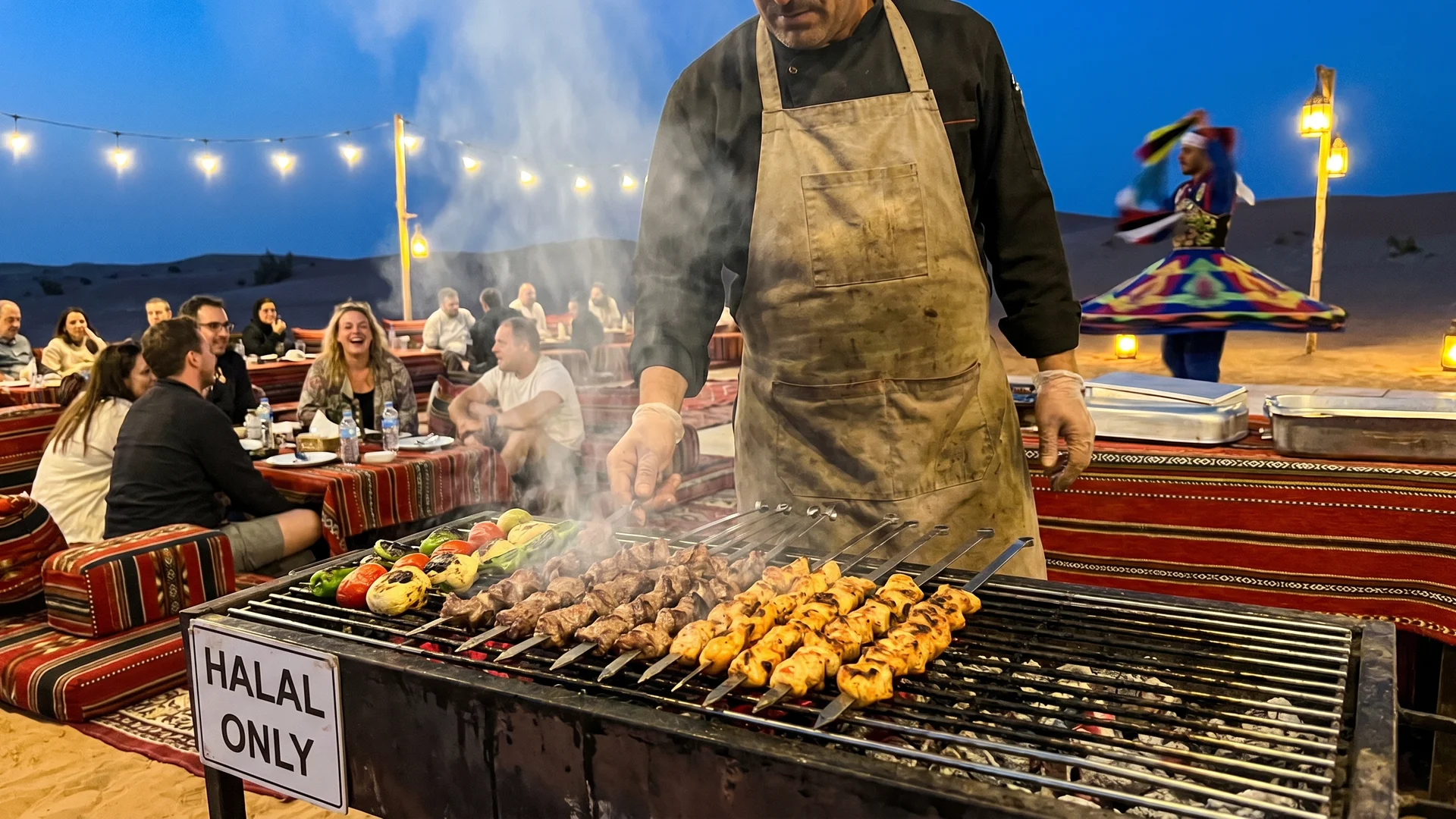
The dune-bashing run, sunset breaking over the ridgelines, the camp, a halal BBQ, and return transfers — all bundled into one evening.
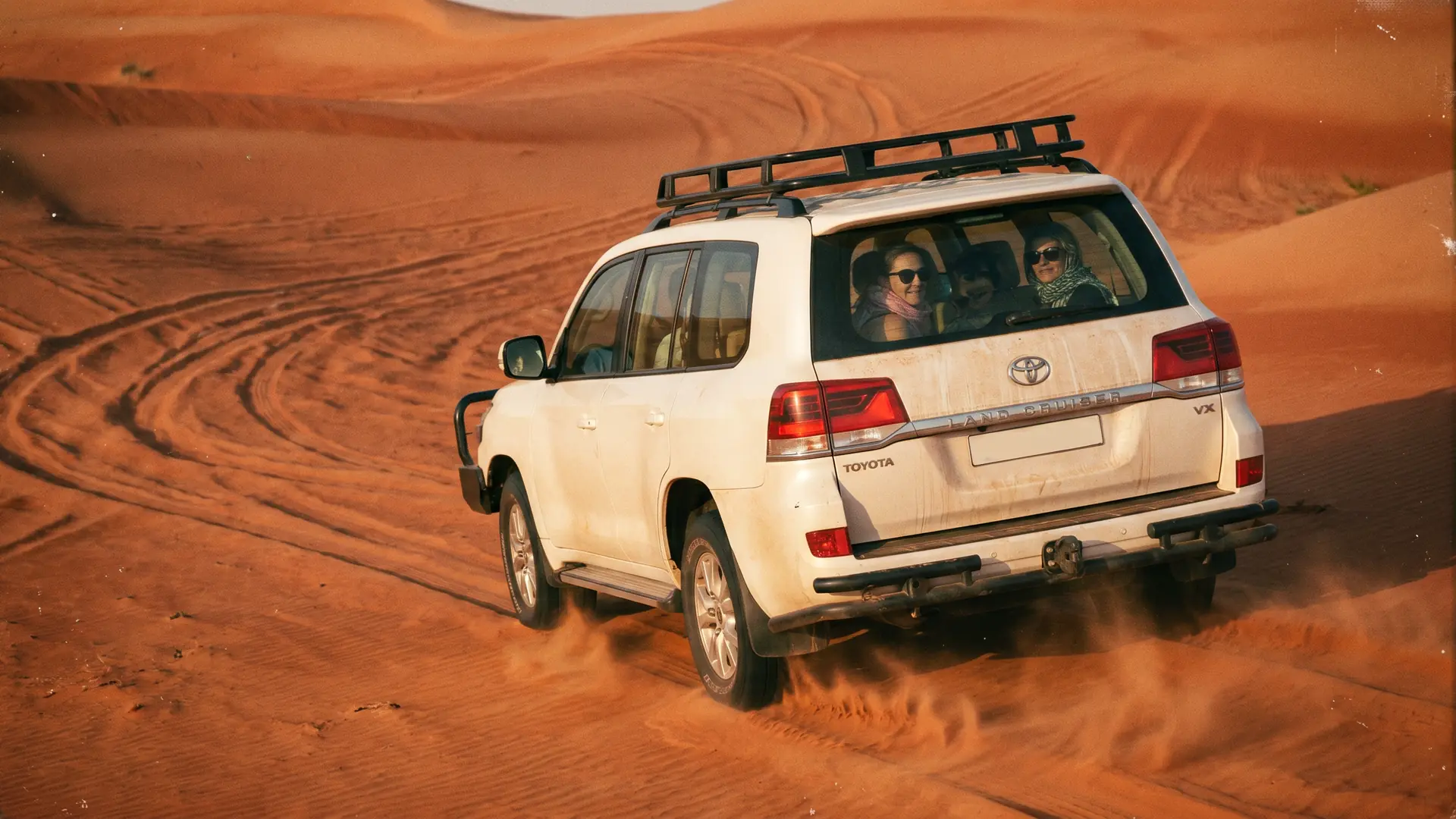
A private vehicle and private seating at the camp, the whole run built around your group alone.
Past these three packages sit a few more options: go private for AED 799 in the morning or step it up to AED 1,400 in the evening, or ask about overnight camping and corporate bookings. Would rather leave the dune bashing out entirely? Say so, and a gentler route replaces it.
Balloon guests get collected around 4:30am and are back with their feet on the ground before most hotel breakfast buffets have closed. None of the throttle control or body position that matters on an ATV applies up there — the pilot flies, you watch. Flights run roughly September through May.
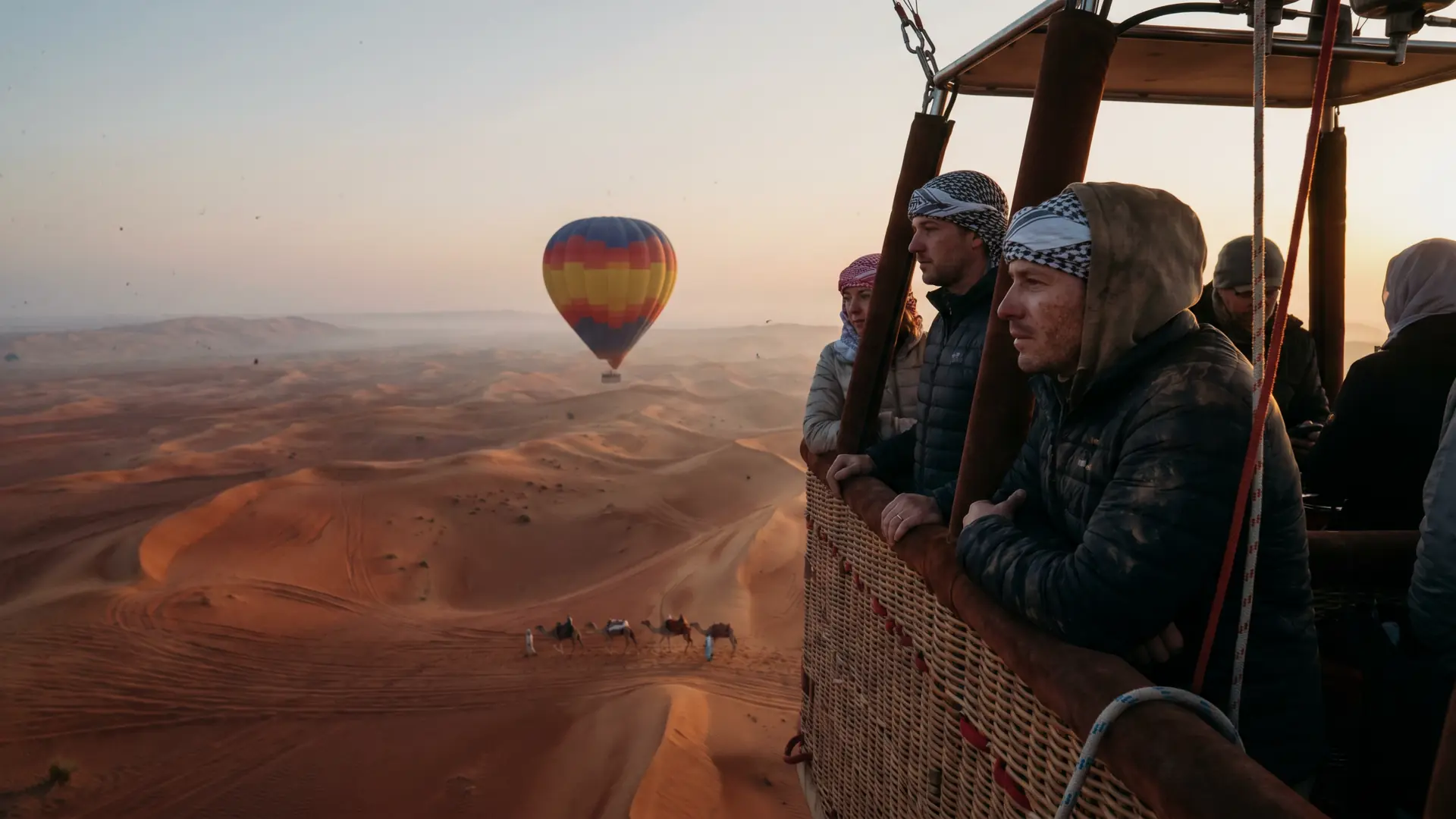
The standard flight is AED 1,049. Add a falconry display for AED 1,149, or go for the full landing breakfast at AED 1,349.
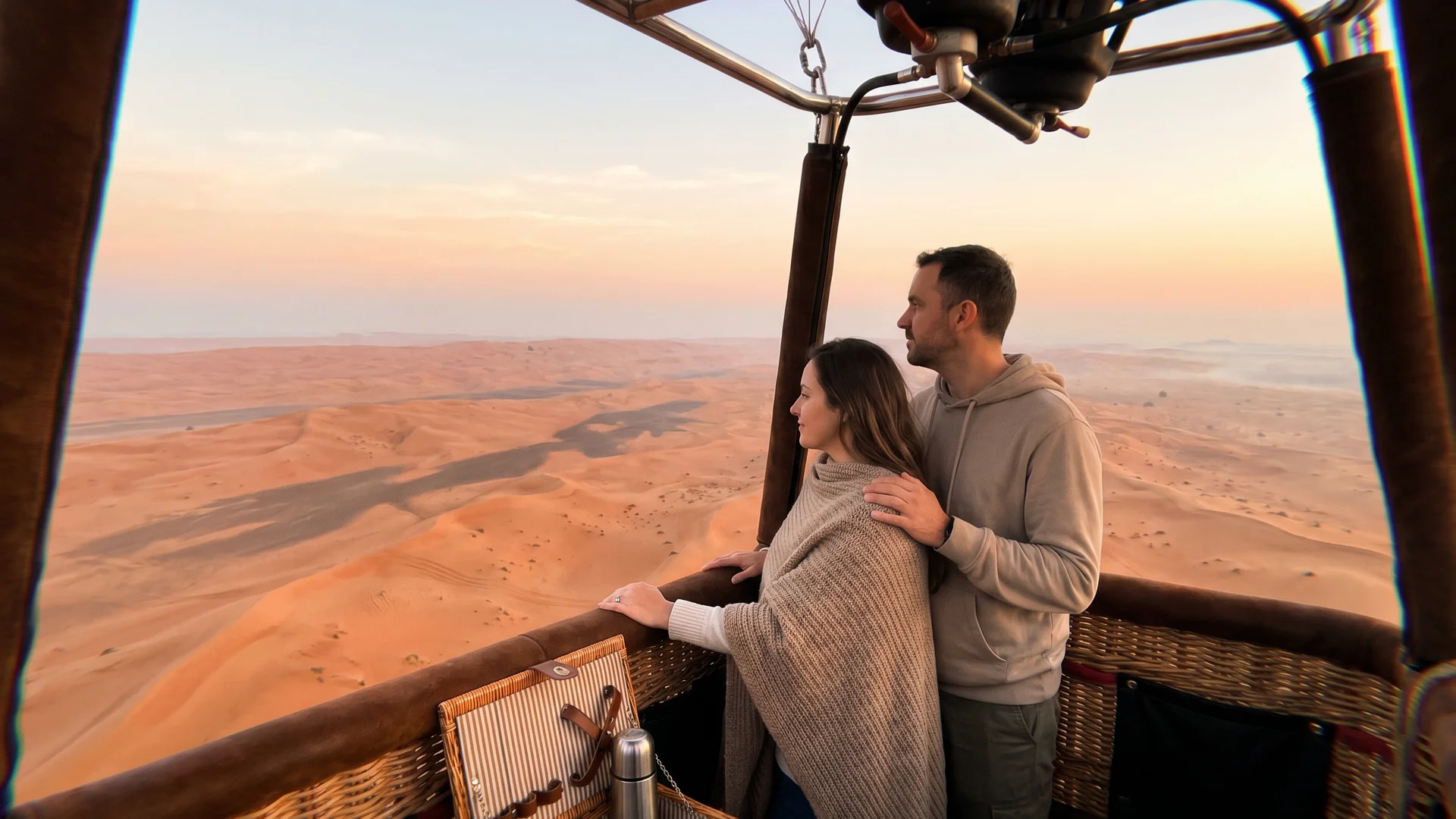
Have the entire balloon to yourselves, a favorite for proposals, anniversary trips and company outings.
A good add-on for the youngest in your group, older relatives, or anyone who watched the Raptor go past and decided riding technique could stay somebody else's hobby.
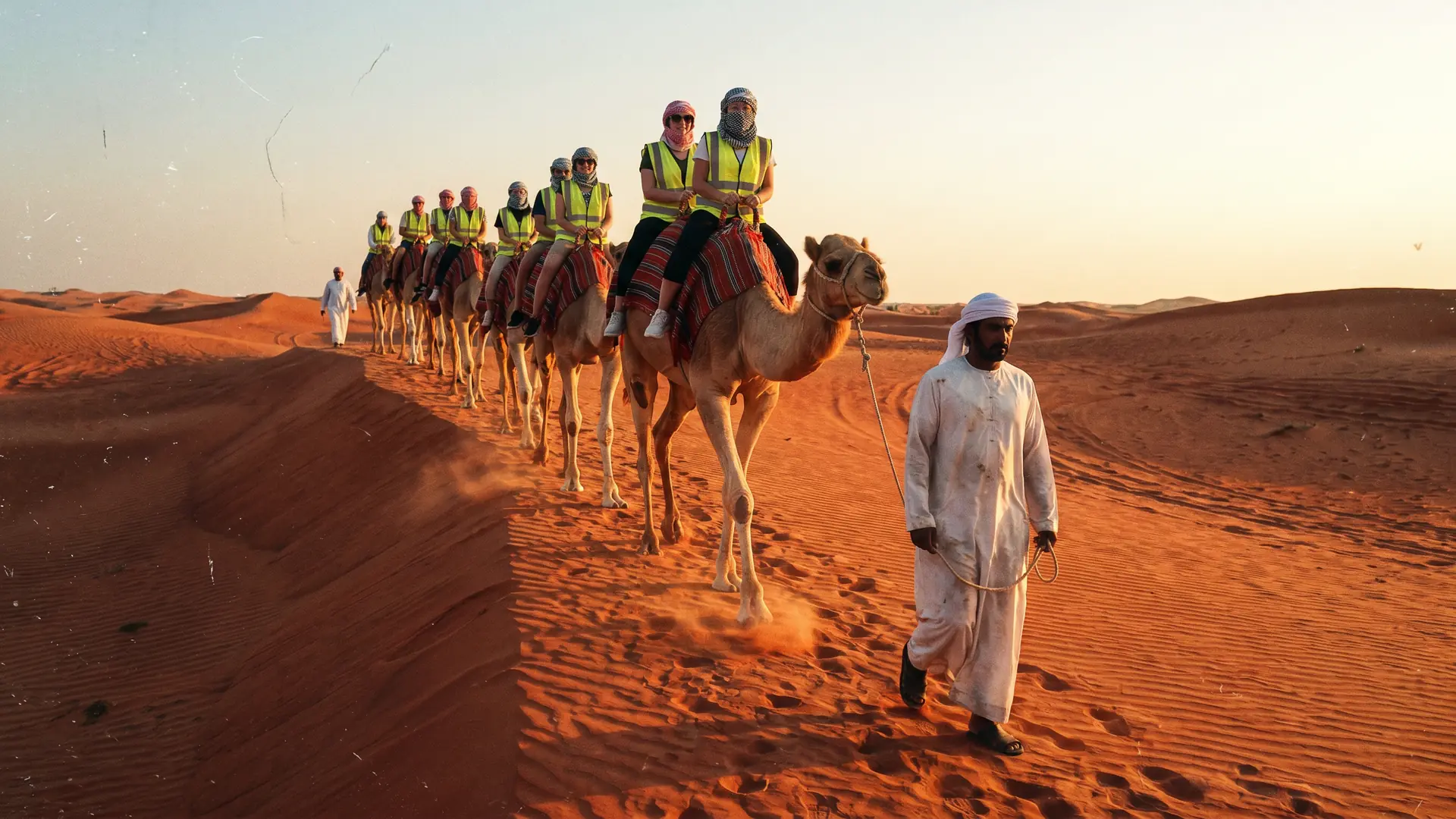
The same dunes the ATVs get coached on host this trek too, guide leading the way, and children as young as three can join as long as an adult rides beside them.
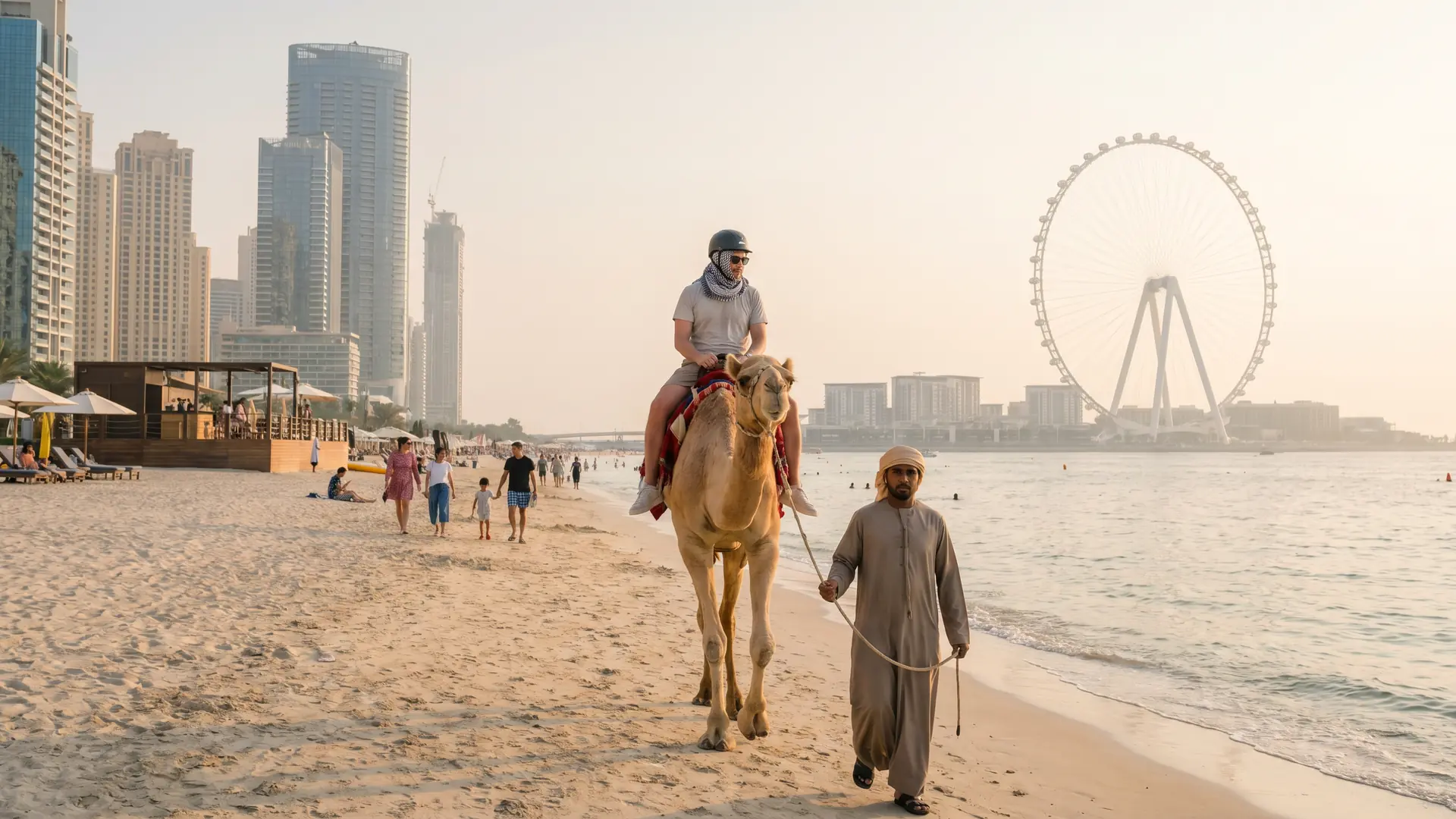
Skip the 45-minute drive entirely — this one sits right on JBR's sand, and it delivers the exact photo most visitors are chasing.
For anyone who already has saddle time, guided desert horse riding is also available, starting at AED 575.
Too many variables for a fixed price list — how many are in your group, which machines you are after, and how much of the day gets booked all swing the final number. Message the details across and a quote lands back the same day.
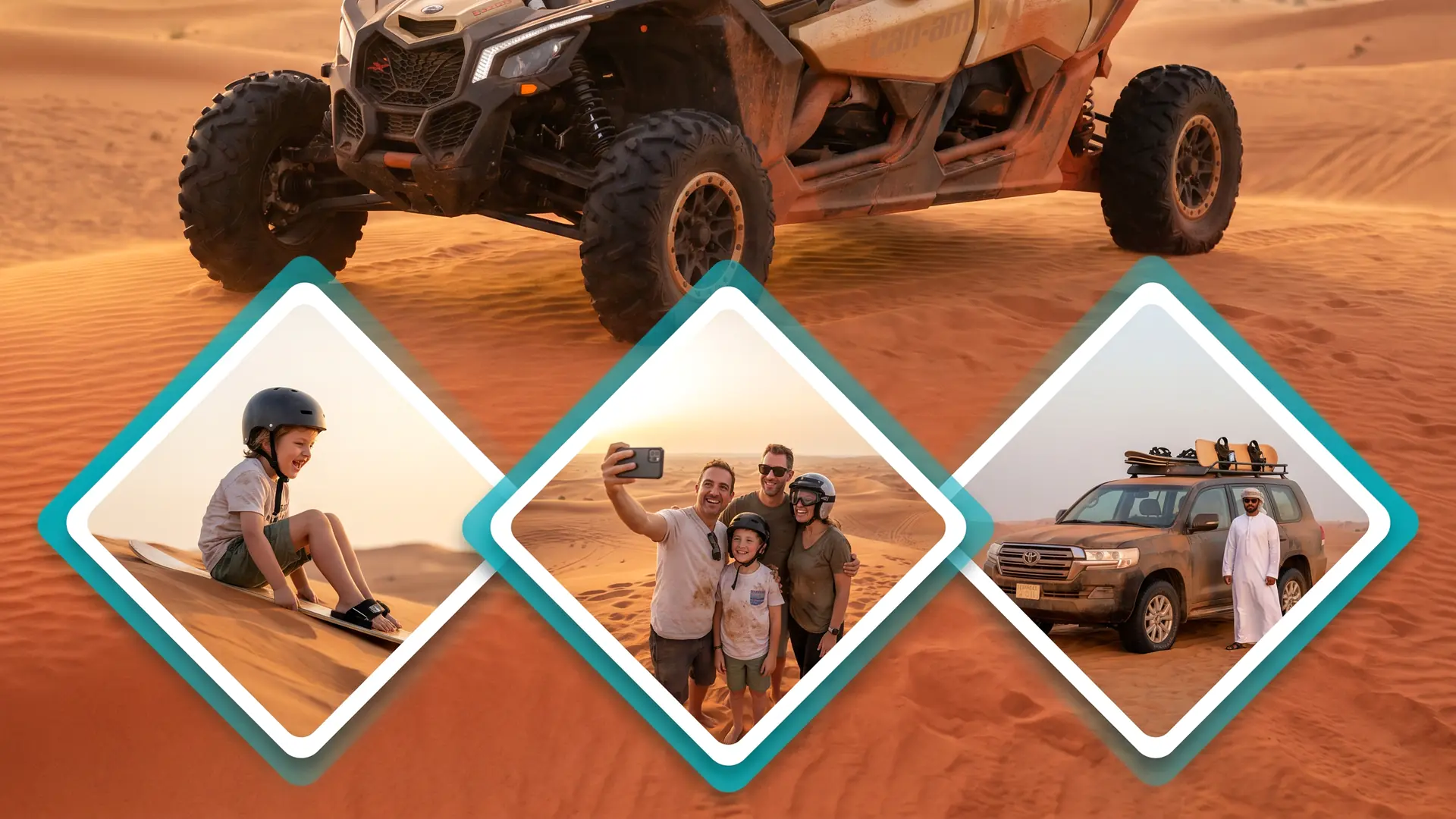
Combine coached ATV time with a buggy, a safari and a BBQ dinner and the bill typically lands anywhere from AED 700 up to AED 2,200. Open the day with a sunrise balloon flight for the full ultimate version.
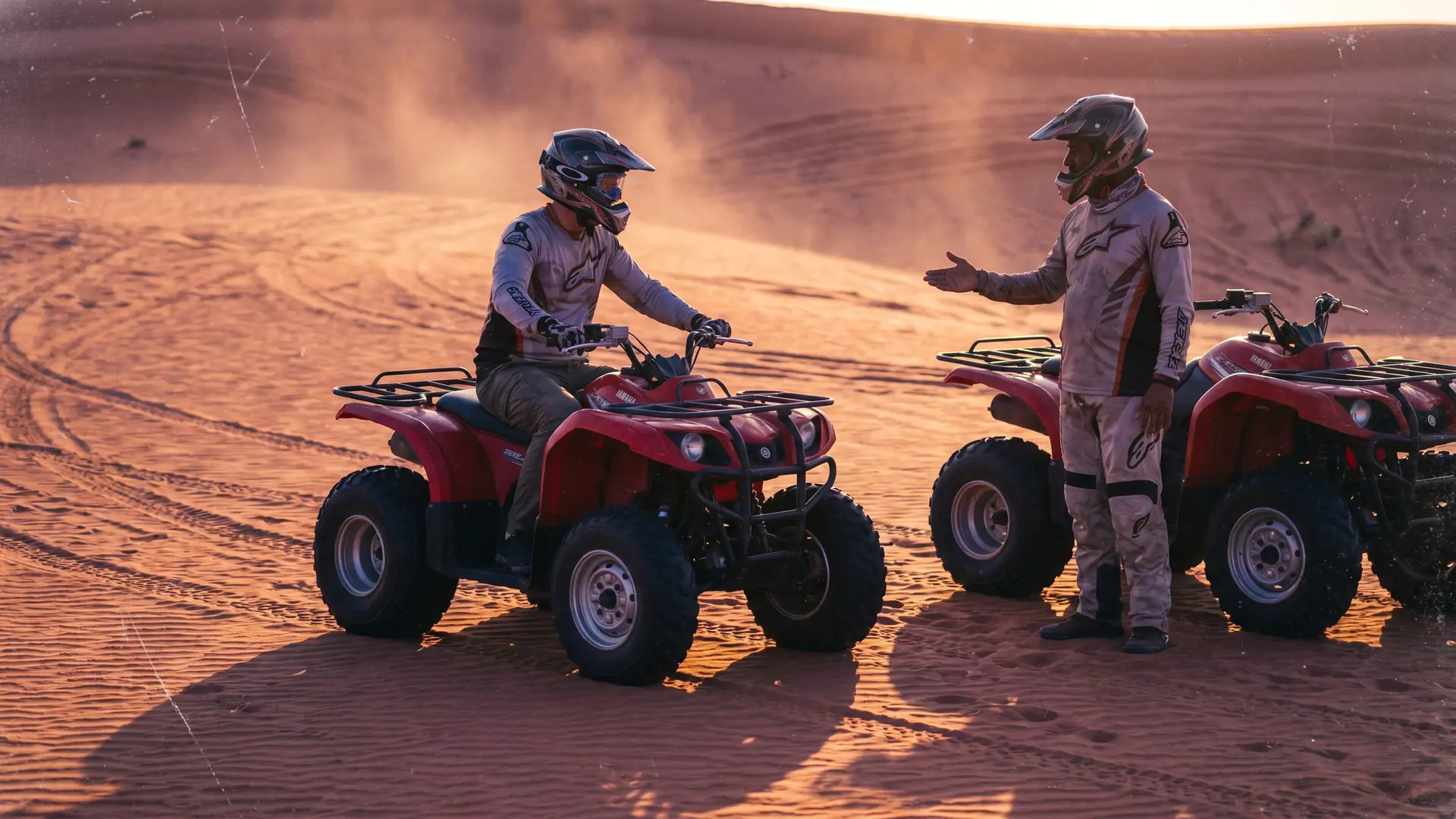
A dozen riders or more, split across ATVs and buggies, each one coached by the same guides on a schedule built around the group.
Al Lahbab is where every session on this site happens, a run of desert on the city's southeast side, just off the Dubai–Al Ain highway. That red-orange tone in the photos is completely unedited — it's really what the ground looks like, and the shape underneath it matches: proper bowls and ridgelines with enough variety that technique genuinely gets tested, unlike the flatter stretch near Al Awir or the heavily-driven sand at Big Red, where years of rental traffic have worn down most of what would otherwise challenge a rider.
The warm-up happens for a reason — nobody gets pointed at a dune before proving themselves on flat, open ground back at base first. It's a small ritual, but it carries the whole coaching philosophy in miniature: it's how a guide figures out exactly what each rider can actually handle.
The same six steps apply no matter what you've booked, from the standard loop to a full day out — the one thing that changes is how long the coached-riding block runs.
City-based riders are picked up directly; anyone making their own way out receives directions to the meeting point right after their booking is confirmed.
Gear and helmet go on first, then the technique walkthrough covers rolling the throttle on instead of stabbing it, where to plant your feet, and the hand signals for slow down and stop.
A handful of laps on flat, open ground while the guide reads your throttle hand and your seating position, and that read is what decides both your machine and your route.
From there you follow the lead rider through the bowls and ridgelines, with corrections on your line and body position called out as the terrain gets tougher.
Back at base for water, a breather, and a quick note on what to work on next time — plus the day's photos, handed over before you head home or move on to whatever else you've booked.
If the BBQ's on your itinerary, the group heads straight to camp from here — no separate stop required.
Riders aged nine to twelve get that same corrective attention on their own 90cc lane, with a guardian never far away. Kids younger than that can still take part — riding along beside a driving adult in a buggy, or climbing onto a camel once they've turned three. Flag any borderline case in your party ahead of payment, not once everyone's already gathered for the briefing, since that's the stage where it can genuinely still be worked out. Dream Land Adventure Tourism is the DTCM-licensed operator behind this fleet, and on the sand itself, your route comes down to how the guide reads your technique.
Based on 762 Google reviews
Based on 1,458 reviews
All eight Yamahas are priced per rider. The supervised kids' 90cc sits at AED 150 on its own track; AED 200 gets an adult started on the 220cc, while AED 795 caps things out on the Raptor 700cc, unlocked strictly after a guide has seen your riding and given the nod. Most beginners settle on the 400cc at AED 250 — the machine the standard coached route is built around. Bolt on the Land Cruiser safari and the BBQ camp dinner, and a morning booking runs AED 290 total, an evening one AED 375.
Two names for one four-wheeled machine. North America defaults to ATV; the UK and this region lean toward quad or quad bike. Either term lands you on the same single-rider Yamaha fleet, with the same guide correcting your technique regardless of which word brought you here.
At Al Lahbab, out on the city's southeast edge off the Dubai–Al Ain road, roughly a 45-minute drive from Downtown. That distance is precisely why coaching is worth doing here — genuine bowls and ridgelines with enough variety to actually test and correct a rider's technique, rather than the flattened strip of sand you'd find closer to the highway.
No licence — this is private desert land, not a public road. No experience either. First-timers make up most of the riders here, and the warm-up and the guide's corrections exist specifically to build your technique from zero rather than assume you already have it.
Guided from start to finish. Your machine is yours alone, but a lead guide chooses the line, keeps an eye on how you are handling it, and jumps in with a correction the moment your technique starts working against you instead of for you. Nobody gets sent off to figure it out solo.
Riders aged nine to twelve are welcome, kept on their own supervised 90cc lane with a guardian close by, at AED 150. The same corrective coaching just runs at a smaller scale there — staff keep an eye on grip and posture on that track the same way the lead guide watches adults on the main route. Kids younger than nine can still come along as a passenger in a buggy, or hop on a camel once they've turned three.
No, it's not built into the rate — pickup gets quoted and agreed as an add-on before payment, covering Downtown, Business Bay, Marina, JBR and Deira as the usual stops. Driving out yourself works equally well; you'll get directions once your booking is confirmed.
Between the drive and the session itself, this fills roughly half your day. The coached ride runs however long you actually booked it for, but Al Lahbab is about 45 minutes out from central Dubai each way, and that round trip is exactly why most riders bolt on a safari or a BBQ dinner rather than making the drive for one short riding block alone.
Closed-toe shoes are the single non-negotiable — sandals simply don't work with footpegs. Round out the list with sunglasses and clothes you won't mourn if sand gets into them; helmets are provided. A buff or scarf for your face is the best extra you can pack, and stashing a spare change of clothes in the car makes the ride home noticeably more comfortable.
It happens on almost every single session — nine times out of ten because a rider backs off the throttle halfway up a dune face instead of powering through it, which is exactly the moment a guide is trained to spot. They loop back, free the machine, and turn the whole thing into the lesson for your next climb. There's no charge and no drama, just a couple of minutes lost.
Go with ATVs when the whole group wants to ride and build technique on their own machine, since it's priced per rider. A buggy suits you better when just a rider or two actually want the wheel, since a single flat fee covers it no matter the headcount. Groups with mixed confidence levels frequently book both and travel through the dunes together behind a single guide.
Yes, but sessions move to the edges of the day — early starts and late-afternoon slots from late May through September, since midday sun over open sand is not something you want to be learning technique through. October to April runs comfortably all day long.
Sandstorms and high wind get a session moved, not cancelled — you are contacted ahead of time with alternative slots at no extra charge. ATVs handle marginal weather better than most activities on this site; it is the balloon flights that actually ground for it.
For a midweek slot, a few days' notice is generally enough; push that closer to a week if you're after a Friday or Saturday booking. Late-afternoon slots go first, and the Raptor 700cc isn't far behind. It's the online payment that actually reserves your machine, with pickup timing worked out over WhatsApp the day before you ride.
The entire point of a session here is riding technique — a guide reads your throttle control and body position at the warm-up, then spends the rest of the route fixing whatever needs fixing. Adult pricing spans AED 200 on the 220cc up through AED 795 for the Raptor 700cc, though most of the actual coaching happens on the AED 250 400cc. Nine-to-twelve-year-olds get that identical corrective approach on a supervised 90cc lane of their own, priced at AED 150. Beyond ATVs, this same operator also runs dune buggy rentals from AED 599, Land Cruiser desert safaris from AED 225, sunrise balloon flights starting near AED 1,049, and camel treks beginning at AED 150.
Above all else, book the evening run pairing dune bashing with your own coached ATV session and a Bedouin BBQ dinner at camp, AED 375 all in. Secure online advance payment confirms your booking. The team stays reachable around the clock if you have questions.
Dune bashing, a coached ATV session, sunset and a camp dinner in one evening.
AED 375Where most first-timers build throttle control from nothing.
AED 200The machine most of the technique work on this site happens on.
AED 250Ages nine to twelve, supervised and corrected the same way adults are.
AED 150Firmer overnight sand, more forgiving while you are still learning.
AED 290Released only after a guide checks your control holds up.
AED 795A private Land Cruiser, your own route, dinner waiting at the camp.
AED 1,400Up in the air at first light, down again before breakfast service ends.
AED 1,049Throttle control. Almost every other first-session mistake — stalling on a climb, snapping sideways in a turn, bogging down in soft sand — traces back to a hand that's either fully on the gas or fully off it, with nothing smooth in between.
New riders treat the throttle like a light switch, because that's how most machines they've used behave — a car pedal, a bike brake lever, on or off. An ATV in loose sand punishes that instinct immediately. Too much throttle spins the rear wheels and digs you in deeper; too little and the machine stalls out halfway up a face it could easily have climbed. The fix guides teach first, before anything about steering or body position, is rolling the throttle on progressively, the same way you would ease a clutch out rather than dump it. Every machine in the fleet gets the same lesson first, regardless of size.
The warm-up on flat, open ground exists mostly to drill this one habit before the terrain gets involved. A guide watches your thumb, not your speed, for the first few laps — a jerky, on-off hand gets flagged and corrected immediately, usually with something as simple as "smoother, not faster." Riders who take that correction seriously in the first ten minutes tend to stop making the same mistake for the rest of the session.
It matters even more here than it would on a packed trail. Al Lahbab's sand stays loose, and loose sand exaggerates whatever your hand does — roll the throttle on smoothly and the machine finds grip that didn't seem to be there a second ago; stab it and you lose grip that was there the whole time. That's a big part of why the coaching here actually means something, unlike Big Red, the well-worn tourist dune nearer the highway, where thousands of tyres every week have pressed the sand down into something that barely tests anyone's technique. Every other section of this guide — cornering, body position, reading the sand — builds on a throttle hand that has already learned to be smooth.
Weight to the outside peg, eyes through the turn rather than at the ground in front of you, and a throttle hand that stays open rather than chopping shut the moment the machine leans. Braking happens before the turn, not during it.
Cornering is where most of the technique taught earlier in a session actually gets tested. The instinct that ruins a turn is braking mid-corner — a rider feels the machine start to lean and grabs a handful of brake out of nerves, which shifts weight forward at exactly the moment it needs to stay planted over the rear wheels. The correction is almost always the same: do your slowing down before the turn starts, then commit through it.
Weight distribution does more work than steering input does. Shifting toward the outside footpeg as you turn keeps the machine's centre of gravity working with you instead of against you, particularly on the loose, sandy surface out toward Al Lahbab where a wheel can lose grip without warning. It feels counterintuitive at first — leaning your body toward the outside of a turn instead of into it, the opposite of what a bicycle or motorbike teaches — which is exactly why guides call it out specifically rather than assuming it will click on its own.
Eyes matter more than most first-timers expect. Staring at the exact spot you are trying to avoid is a near-universal beginner habit, and it tends to steer you straight toward it — a small dip, a rock, another rider's dust trail. Guides will often just say "look where you want to go," and it is one of the few one-sentence corrections that produces an immediate, visible change in how someone rides. Get all three pieces working together and you actually carry more speed through a turn than a rider who is braking, wobbling and stabbing the throttle to catch back up.
Stand on the pegs, not sit, once the ground gets rough — knees bent as your suspension, weight forward on climbs and back on descents. Sitting rigid through bumpy terrain is the fastest way to finish a session with a sore back.
Sitting down feels like the safer, more stable option to a first-timer, and it is actually the opposite. A seated rider has no suspension between the machine and their spine except the seat cushion, so every bump transmits straight up their back. Standing on the pegs with bent knees turns your legs into a second suspension system, absorbing the jolt before it ever reaches your torso — which is why guides move riders off the seat the moment the terrain stops being flat.
Where your weight sits matters as much as whether you are standing. Climbing a dune face, shifting forward keeps the front end weighted enough to steer rather than wandering; coming down the back side, shifting rearward keeps the rear wheels loaded so they do not wash out from underneath you. Riders who keep their weight dead-centre regardless of the terrain end up fighting the machine on every transition instead of working with it.
Arms should stay relaxed and slightly bent, not locked straight. A locked elbow transmits every bump directly into your shoulder, and it also makes small steering corrections slower — bent arms act like shock absorbers for your upper body the same way bent knees do for your lower half. This is the correction guides give most often right after throttle control, usually within the first few minutes of actual dune terrain, and most riders who get it are noticeably more comfortable, not more tired, by the end of the session.
Noticeably. Guides routinely see a rider go from a white-knuckle grip and a stabbing throttle at the warm-up to a relaxed hand and a smooth line by the end of a single session — one of the more visible before-and-afters in adventure tourism.
It helps that the feedback loop is short. On a bicycle or a ski slope, a technique correction might not show its results for days of practice. On an ATV in soft sand, a bad habit produces an immediate physical consequence — you bog down, you stall, you understeer wide — and a good habit produces an improvement you can feel through the machine within the next few minutes. That speed is what makes a single session more useful here than the length alone would suggest.
The warm-up-to-finish comparison is the clearest evidence. Most riders arrive gripping the handlebars far harder than they need to, sitting rigid, and treating the throttle as on-off. By the midpoint of a standard session, after two or three corrections from the guide, the grip has loosened, the throttle hand has smoothed out, and the body has started shifting with the terrain instead of against it. None of that requires natural talent — it is mechanical repetition of a handful of specific corrections.
What does not fully form in one session is instinct — the point where good technique happens without conscious thought. That typically takes a few visits, which is exactly what the safari-and-ATV combinations are built for, since riders who stack a second session onto a return trip usually get moved onto a longer or harder line within the first few minutes. What lands fast is the vocabulary: most riders leave able to name exactly what they were doing wrong at the start, which is most of the battle. Improvement compounds with attention, not just time on the machine — two riders doing the identical route see very different results if one is actively taking corrections and the other is just holding on and hoping the ride ends well.
Death-gripping the handlebars, chopping the throttle instead of rolling it, braking mid-turn, sitting rigid over bumps, and target-fixating on the exact obstacle they are trying to avoid. All five get corrected the same way — named out loud, the moment they happen.
The white-knuckle grip is the most common and the most self-defeating. Riders tense their forearms out of nerves, which makes the handlebars feel heavier and the machine feel less predictable, which makes them grip harder — a loop that gets worse the longer it goes uncorrected. Guides catch it early, usually at the briefing or the first lap of the warm-up, and the fix is almost embarrassingly simple: shake your hands out, breathe, hold the bars the way you would hold a steering wheel you trust rather than one you are fighting.
Chopping the throttle — snapping it fully open or fully shut instead of rolling it — shows up constantly on climbs, where a nervous rider backs off exactly when commitment is needed most and the machine loses momentum and bogs down. Braking mid-turn is its cousin, a fear response that shifts weight the wrong way at the wrong moment. Two wheels punish this far less forgivingly than four do, which is one reason the dirt bikes here are gated behind a rider check rather than handed out freely.
Target fixation is the sneakiest one, because it feels like caution rather than a mistake. A rider spots a rock or a soft patch, stares at it, and steers straight toward it without meaning to — eyes lead hands more than people realise. "Look where you want to go, not where you don't" is one of the most repeated lines a guide will say over a session, because it is one of the few corrections that fixes itself the instant a rider actually hears it. None of these five get treated as failures — a guide correcting a mistake mid-ride is the entire point of a coached session rather than a bare rental.
Yes, on the two machines where it matters. Everything from the 90cc up through the Grizzly 450 runs an automatic CVT with a thumb throttle, so technique is entirely about throttle, brakes and body position. The 625cc sports quad and the Raptor 700cc add a manual clutch and foot shift on top of all of that.
Most of the fleet is automatic by design, because it removes one variable from a first-timer's plate. A thumb throttle and two brake levers is a small enough control set that a rider can focus entirely on reading the terrain and adjusting their body rather than splitting attention between the machine's mechanics and the ground in front of them. That is a deliberate choice, not a limitation — the 400cc that most sessions are built around is automatic specifically so the coaching can focus on the technique that transfers to every machine on the fleet, the same way it transfers to a buggy, which also does its gear-changing for you.
The 625cc sports quad and the Raptor 700cc are different animals. Both are manual-clutch machines with a foot shifter, which means a rider is now managing clutch feel and gear selection on top of throttle, brakes and body position — and doing it while standing on moving terrain rather than sitting in a driveway. That is a meaningfully higher cognitive load, which is exactly why those two machines are gated behind a rider check rather than handed out on request.
The good news is that clutch control transfers from other machines almost completely — anyone who has ridden a manual motorbike, or driven a manual car reasonably well, picks up the coordination fast, because matching clutch release to throttle input is the same underlying skill in a new context. What does not transfer automatically is doing that coordination while also managing everything the automatic riders had to learn — throttle smoothness, body position, cornering. It is additive, not a replacement, which is exactly why nobody starts on the Raptor: the automatic machines build the foundation first, and the manual ones add one more layer once that foundation is solid.
You can ask for it, and most riders who do get more of a guide's attention on the warm-up and through the route. What this is not is a structured lesson curriculum — it is a safety briefing followed by real-time correction, not a formal riding school with levels or certificates.
It is worth being precise about what is actually on offer here, because the honest answer sits between two things people sometimes expect. This is not a certified riding academy with a syllabus and a graded outcome at the end. What it is: a controls and technique briefing before you ride, a warm-up where the guide reads your handling and body position, and a lead guide watching the whole group through the route and stepping in with corrections whenever something is worth fixing. That correction is real coaching, even without the formal packaging.
Asking for more attention works, within reason. A rider who says at the briefing that they specifically want to work on their cornering or their throttle hand tends to get exactly that — more direct feedback, a slightly longer warm-up, a guide who checks in on that specific thing more often through the ride. It does not cost extra and it does not require booking anything special; it just means saying it out loud instead of assuming the standard briefing is all that is available.
What it cannot turn into is a private lesson with a guide riding beside you the entire time, ignoring the rest of the group. Sessions run with other riders on the same route, and a guide's attention is genuinely split across everyone in it — the correction you get is real, but it comes in the gaps between watching the whole line, not as continuous one-on-one commentary. Anyone who wants that level of individual focus should ask about a private booking rather than expect it inside a standard group session. The honest takeaway: come with specific things you want to improve, mention them at the briefing, and the coaching that already happens on every session gets pointed more directly at you.
Individually, in practice, even though the group rides as one line. The guide watches whoever is closest to trouble at any given moment, and over a full session that attention rotates through everyone at least once. Riders who look solid get left alone to enjoy the route; riders still finding their throttle hand get more corrections, not fewer.
It genuinely lands from around nine or ten, which is why the supervised 90cc track uses the same corrective approach rather than just letting children loop unsupervised. Younger than that, grip strength and reaction time are still developing, and the lane is built around safe fun rather than building riding technique.
Some of it carries over — reading a line, weighting your outside foot through a turn, keeping your arms relaxed — but a thumb throttle and four-wheel stability behave differently enough that the guide still runs the same warm-up on everyone. What changes is where the coaching starts, not whether it happens.
Yes, and it is one of the first things a guide points out to anyone who rides both. Firm morning sand rewards a lighter throttle and forgives small technique errors; soft afternoon sand needs earlier weight shift and more commitment, and a habit that worked at nine in the morning can bog you down by three in the afternoon.
The warm-up still happens, but it runs shorter for a rider the guide recognises or who shows solid throttle and braking control in the first lap or two. Think of it less as a test you can fail and more as a quick recalibration, since even returning riders arrive a little rusty.
Technique does almost all of the work. Closed shoes are required for safety rather than grip, and gloves are offered but optional — most riders find bare hands read the throttle and brake levers better. Nobody has ever been held back by their footwear; riders get held back by grabbing the throttle instead of rolling it on.
Returning riders get read again at the warm-up and, if they show it, moved onto a longer or more demanding line instead of repeating the exact loop. The coaching compounds — a guide who has seen you ride before corrects faster because they already know what to watch for.
Guides carry a phone for the route photos included with every session, and those often catch a rider mid-corner or cresting a dune, which doubles as a rough record of your form. It is not a filmed lesson, but the shots handed over afterwards are usually enough to see what your body was actually doing.
The core mechanics stay the same, but a guide adjusts the advice slightly — a taller rider is told to stand a touch more so their height works for their balance rather than against it, and a heavier rider often benefits from committing to the throttle a fraction earlier on soft climbs. Machine choice matters here more than technique does; the Grizzly 450 carries extra weight better than the 220cc, and the same logic pushes bigger riders toward the Can-Am Maverick X3 or the newer Maverick R rather than the entry-level RZR next door in the buggies.
Within reason, no. The guide sets the pace on shared sections, but a rider who is clearly ahead of the group gets given more of the route — a wider line, a steeper face — rather than told to sit and wait. The group only gets held together where safety genuinely requires it, like blind ridgelines and photo stops.
Choose your machine and lock it in online; your pickup time then gets nailed down on WhatsApp the night before your session.